In the PHP community, "persistent connections" are often treated like a dark art; powerful, but prone to blowing up in your face. We've been told they cause "Too many connections" errors, stale data, and dangling transactions.
The truth? In high-traffic environments, persistent connections are your best friend. If you understand how PHP internals and networking flows actually work, they are the single most effective way to slash latency and stabilize your database.
The "Connection Tax": What You Pay Every Request
Every time you call new PDO() or mysqli_connect() without persistence, your server begins a grueling marathon. Before a single byte of SQL is executed, the following must happen:
- DNS Resolution: Converting
db.example.comto an IP. Even with caching, this is a network hop. - TCP 3-Way Handshake: The client and server exchange
SYN,SYN-ACK, andACKpackets. This requires a full round-trip (RTT) - SSL/TLS Negotiation: If you use encryption (standard for cloud DBs), this is the "heavy lifter." It involves exchanging certificates and negotiating keys, often taking 2-3 additional round-trips.
- Database Authentication: The final verification of credentials.
Figure 1: The Standard Connection Lifecycle Overhead
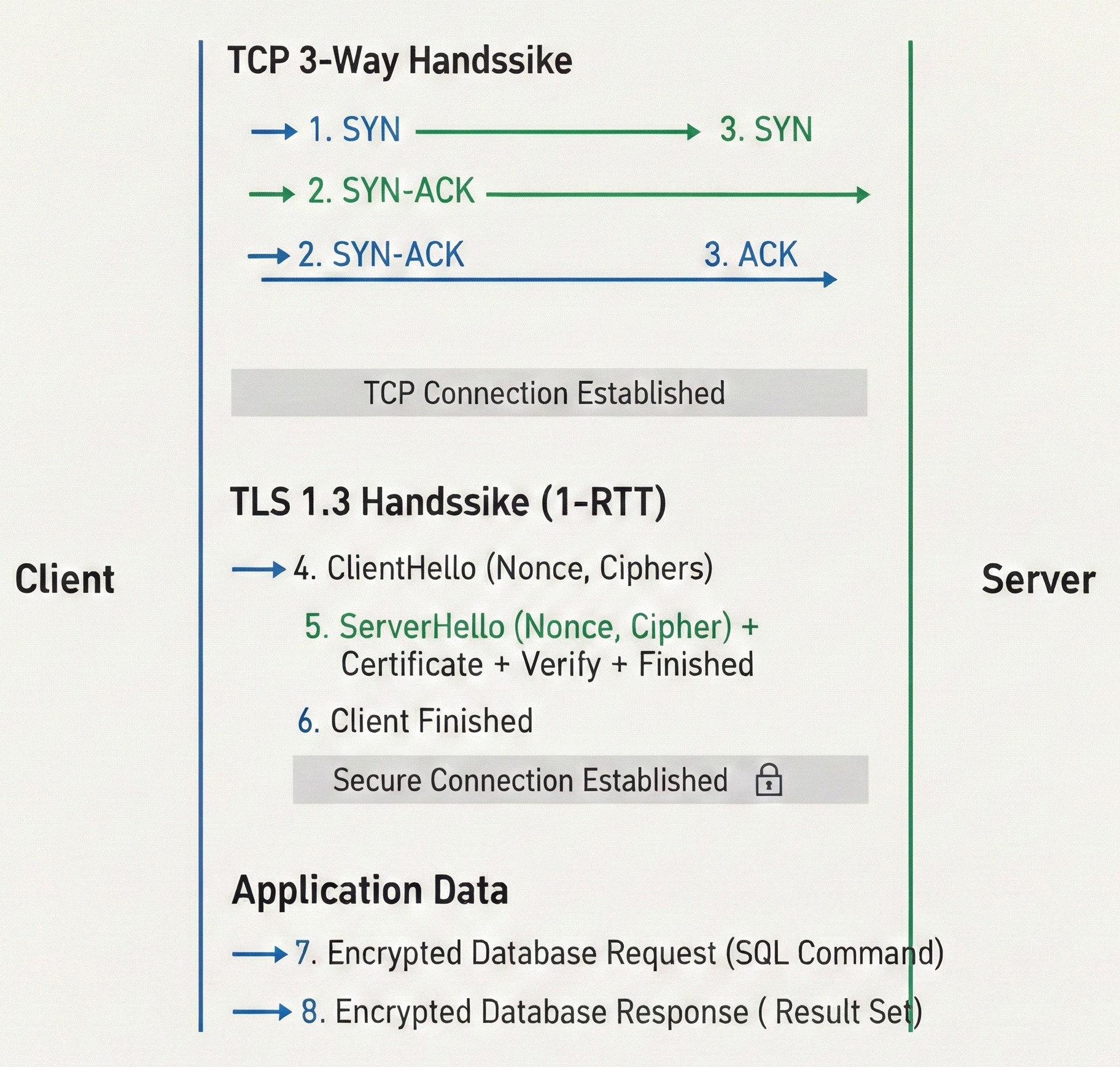
The Cumulative Cost: In a modern cloud setup, this "tax" can cost 20ms to 100ms. If your query takes 2ms, but connecting takes 50ms, your app is spending 96% of its time just opening the door.
The Internal Secret: The Hash Map Lookup
When you enable persistence (e.g.,PDO::ATTR_PERSISTENT => true), PHP changes its strategy. Instead of calling the OS network stack, it uses its internal Persistent Resource Table.
How it Works:
- Hashing: PHP calculates a unique hash based on Host, Port, User, and Password.
- The Look-up: It checks its internal hash table (the
plist) for that key. - The Result: If found, PHP hands the resource pointer to your script. This is an
O(1)operation a memory lookup that takes microseconds.
Figure 2: PHP's Internal Persistent Resource Lookup
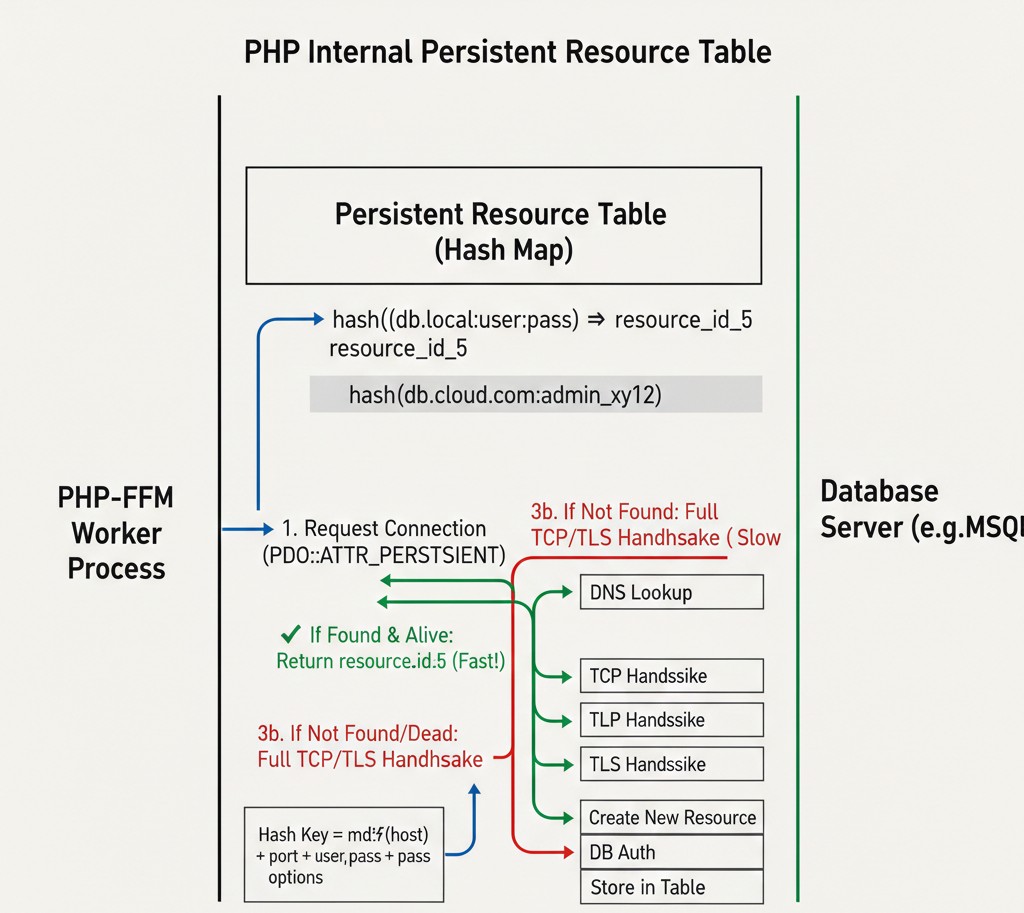
Because this happens in memory, "opening" a persistent connection is virtually free. It consumes only a few hundred bytes of RAM to store the file descriptor, making the memory overhead negligible.
Solving the "Risks": Stability and Safety
The myths about persistent connections usually come from poor configuration. Here is how you make them bulletproof:
1. Eliminating Stale Connections
A "MySQL has gone away" error happens when the DB closes an idle connection, but PHP keeps the socket.
- The Database Fix: Set your
wait_timeoutor equivalent to a high value (e.g., 8 hours). - The PHP-FPM Fix: Use Worker Recycling. By setting
pm.max_requests = 1000in your PHP-FPM pool config, the worker process will terminate and refresh after 1,000 requests. This gracefully closes old sockets and clears any minor memory bloat. - The PHP-FPM Fix Continued: Eliminate idle processes. By setting
pm.process_idle_timeout = 10sandpm.max_spare_servers = 5you ensure that no more than 5 idle processes that haven't done anything for 10s or more are around and are pointlessly consuming memory & sockets.
2. Preventing Dangling Transactions
The biggest fear is that Script A leaves a transaction open (BEGIN), and Script B inherits it.
This is easily solved with a "Safety Net" in your application's lifecycle (Also an opportunity to emit errors to catch code flows leaving dangling transactions).
- Laravel/Modern Frameworks: Use a
terminate()middleware to check the transaction level. - Vanilla PHP: Use
register_shutdown_function().
// The global shutdown safety net
register_shutdown_function(function() use ($pdo) {
    if ($pdo->inTransaction()) {
        $pdo->rollBack();
    }
});
Why Persistence is Actually SAFER
Surprisingly, persistent connections protect your database from Connection Spikes.
- Without Persistence: A traffic surge of 1,000 users results in 1,000 simultaneous TCP/TLS handshakes. This "Thundering Herd" can crash a DB's networking layer.
- With Persistence: The number of connections is naturally capped by your
pm.max_childrensetting. If you have 50 FPM workers, the DB only ever sees 50 connections. The load is smoothed out, and the DB stays responsive.
The Connection Pooling Misconception
When developers realize that PHP doesn't have a built-in cross-request connection pool, they often reach for an external proxy. However, there is a massive catch: A proxy is still a network hop.
The "Proxy Tax"
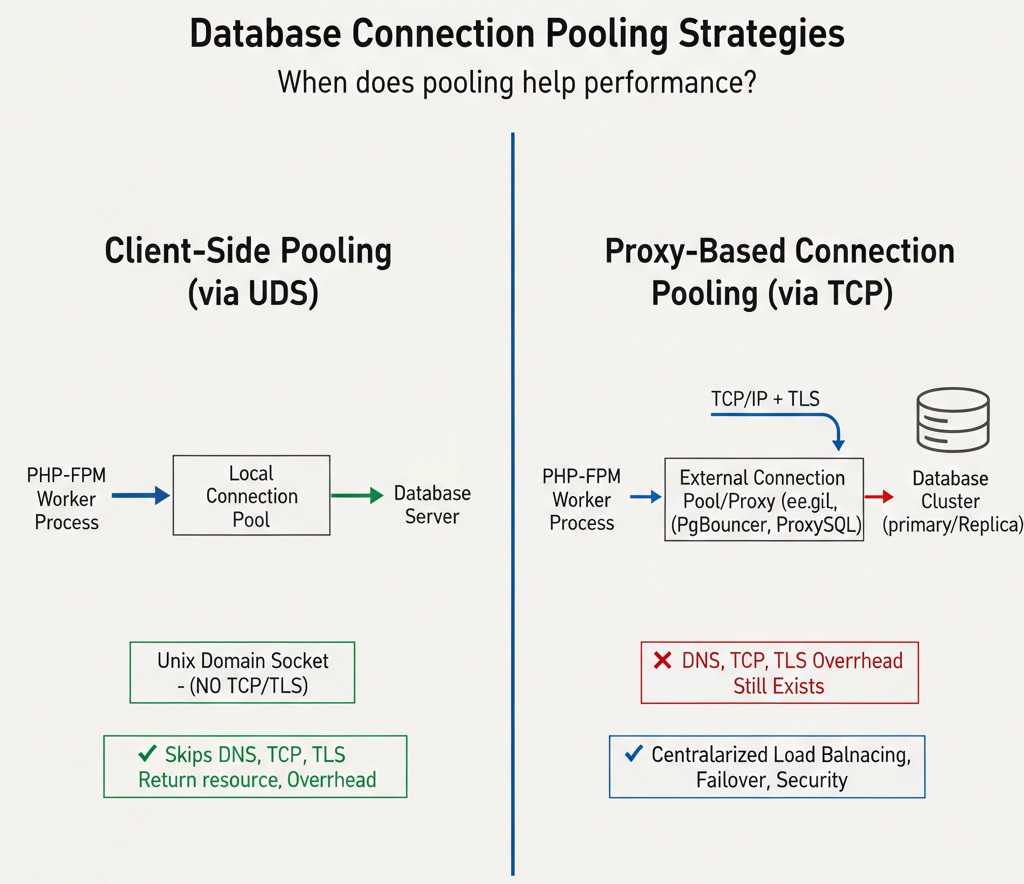
If your connection pooler (ProxySQL, PgBouncer, etc.) is located on a different server or even a different container accessed via TCP/IP, you haven't actually solved the latency problem.
- Your PHP script still has to perform a DNS lookup, a TCP handshake, and potentially a TLS negotiation to talk to the proxy.
- You have simply moved the "Connection Tax" from the Database to the Proxy.
When Pooling Actually Matches Persistence: UDS
Connection pooling only matches the performance of PHP's persistent connections if the connection to the pooler is "virtually free." This is only possible via a Unix Domain Socket (UDS).
- Unix Domain Sockets: These happen entirely within the OS kernel. There is no routing, no TCP overhead, and no DNS.
- The Comparison: PHP Persistent Connections use an internal memory hash; a local UDS proxy uses a local file-based socket. Both are lightning-fast.
Figure 3: Comparing Local UDS vs. TCP Proxying
If not for speed, why use a Proxy?
If persistent connections are faster, why does the industry use proxies? The answer is Management, not raw Latency.
- Load Balancing: A proxy can transparently shift traffic between a primary and multiple replicas.
- Failover: If a DB node dies, the proxy redirects traffic without the PHP app ever knowing.
- Connection Concentration: If you have 5,000 PHP-FPM workers across 10 servers, you can't have 5,000 persistent connections hitting one DB. A proxy "funnels" those 5,000 incoming requests into a smaller, stable pool of 100 connections to the actual database.
In Conclusion
Persistent connections aren't dangerous; they are an optimization tool that leverages PHP's process model to its fullest. By skipping the DNS/TCP/TLS "tax" and using a microsecond-fast hash lookup, you transform your application's performance. Use Proxies for high-availability, load balancing, and managing massive horizontal scale.
The Golden Rules:
- Use
PDO::ATTR_PERSISTENT => true. - Match DB wait_timeout to your traffic.
- Recycle workers with
pm.max_requestsand manage idle processes withpm.process_idle_timeoutandpm.max_spare_servers - Always rollback uncommitted transactions on shutdown.
P.S. A History Lesson: Where did the "Fear" come from?
If you ask an experienced sysadmin about PHP persistent connections, they might shudder. This historical fear is rooted in the era of cheap Shared Hosting (often running Apache with mod_php).
In those environments, hundreds of unrelated users shared the same web server. Because PHP's internal connection hash includes the database username and password, every user created unique persistent pools.
The "Shared" Nightmare: If a server hosted 50 users, and each user had 3 different apps with different DB credentials, a single Apache process could end up holding nearly 150 idle connections open to the MySQL instance. Database connection slots were quickly exhausted, crashing the server for everyone.
Hosting providers almost universally banned persistent connections to survive. However, in today's world of Containers, VPS, and isolated Cloud functions, your PHP processes serve only your application. The "noisy neighbor" risk that made persistence dangerous in 2005 no longer applies to modern architecture.
Guide to PHP Security